THE BIRTH OF SOUTH
SIMCOE HERITAGE RAILWAY
By Royce Mabee
This story actually begins when the Tottenham and District Chamber of Commerce hosted a Canada ball for Canada day with a dinner and dance at the Tottenham Community Centre with special guest Lieutenant - Governor the Honorable Pauline McGibbon.
This ball cost the Chamber much more than they made so in order to get us out of the red, in 1980, Ruth Mabee suggested having an exposition to showcase our local entrepreneurs. With Ruth as Chairperson we started what was then known as a Trade Fair. To our knowledge this event had never been attempted by any community north of Toronto. We did make some money from this show, and since that date it has become an annual event for the last 24 years. This has since been copied by many towns, villages, hamlets and communities over the years.
About 1983 the Chamber met with some
teachers from Georgian College to discuss a project for some students. They
agreed to do an industrial strategy study for Tottenham and the Chamber as part
of their school curriculum. One of the
recommendations from this study was that the Tottenham-Beeton area would
benefit from a tourist attraction.
About 1985 the Chamber found out that
CNR was attempting to sell their rail line, which ran through Cheltenham,
through Tottenham and up to Barrie.
Ruth Mabee, as president of the Chamber, formed a committee to attempt
to buy the line through Tottenham and at least up to Beeton.
Many officials at CNR seemed amused that a
woman was negotiating the sale and went out of their way to help. Upon closing
the deal one official called Ruth to say “I think you will be happy with what
we have done”. Ruth apprehensively asked, “What have you done?” He replied,
“Instead of five hundred feet south of Mill Street we have given you the rail
land down to the third concession”.
This was quite a nice surprise. After months of negotiations with CNR
the Chamber and CNR agreed on a sale, but first, with the line being abandoned
it had to be offered to the province, the county and the municipality, in that
order. It was up to the Chamber to get
a letter from each of these parties, signed and stating that they relinquished
their claim to the line. With this
paperwork completed we now were able to proceed with our deal with CNR.
The Chamber now owned the land from the
third line of Tecumseth Township to Beeton and the rails from just south of
Mill Street in Tottenham to the Main Street in Beeton.
This sale did not include the Tottenham
Station land; this land was purchased at a later date. What is rarely known about this purchase
is that the Chamber borrowed money from CIBC in Tottenham, but as security,
some members of the Chamber had to sign a personal note for $40,000.00 each
which showed the faith these chamber members had in the project. Now we had a rail line nearly 5 miles
long, so. we now needed a train. It was
learned that Ontario Rail Association had an antique train for which they had
unsuccessfully been trying to find a home.
When we presented our proposal to them they appeared very suspicious
because they had been refused so often which led them to believe that we would
be unable to get the necessary approvals.
They had dealt with large towns and areas such as Cheltenham, Fergus and
Collingwood with no success and we were a small town without experience in
these matters. While Ruth Mabee was in Richmond Hill
hospital, as a patient, recovering from a knee operation she arranged a meeting
in her hospital room with some members of Ontario Rail.
She negotiated an agreement and embarked to
obtain township and neighbour approvals.
After approval was obtained from the township we were left with the task
of obtaining the approval of local homeowners. A number of home and landowners
near the track were against having the train.
We got complaints ranging from “The train will shake our house down” to
“Our lawns will be covered an inch deep with soot from the engine”.
We visited all those who complained and were
able to abate their fears somewhat. The
majority of people were very supportive. Next came
the job of clearing the way for the actual arrival of the train in
Tottenham. Ontario Rail were still not
convinced that we could be successful and were reluctant to bring the train
into the control of the Chamber. In the spring of 1986, at a meeting of Chamber
members and Ontario Rail members at Albion Hills restaurant a delivery date was
discussed. Ontario Rail members stated
that it would be months before they could bring the train here, maybe even
years, because of the amount of work necessary to make the move possible. Ruth
Mabee made an announcement that the train would be here by August 1st.
This did not go over too well with Ontario Rail, but Chamber members were
ecstatic. Now to get the train moved! We contacted CNR to get the motive power
for the move. The train was presently in the MacMillan CNR yard at
Concord, Ontario and CN were very glad to move it.
They sent a crew out to check and repair the line and shore up
the bridges on the line from Barrie to Beeton.
So, on August 1, 1986 the train arrived at Beeton after a seventeen-hour
trip from Concord to Barrie and back down the line to Beeton. This was because
of many delays and the fact that they could not travel over 5 miles per hour
because of the condition of our train and the track from Barrie to Beeton.
With the train now in Beeton we had to start
the task of rebuilding the line. It had
been laying idle for so many years much work was needed. Ruth Mabee had already
purchased over 57 tons of steel rail, 3,000
railway ties, connecting bolts and splices, plus a
steam powered turntable as part of
her deal with CNR.
SO NOW THE WORK BEGINS. With this work underway, we had 22
pieces of rolling stock, a diesel engine in barely working order, two box cars,
about 10 passenger cars including the Temagami, a business car that had pear
wood decorative interior and featured the traditional open rear platform often
used by politicians to make speeches at rail stops.
Also we had two steam engines not yet in working order.
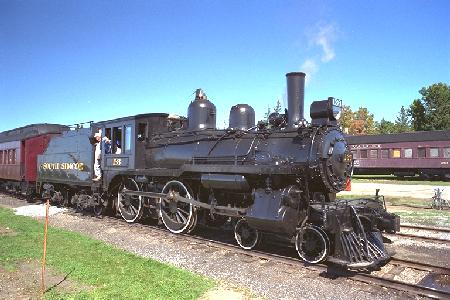
These engines included the smaller #136, an
engine built in 1883; this engine starred in the movie “The National Dream”;
the second steam engine was #1057. This
engine is larger and heavier; it was built in 1912.
In addition there were some work cars and other cars, which were
in bad repair but their carriages, were in fair condition. So began many years of hard work, not
only on the rail line, on passenger cars, on engines, but also repairing damage
by vandals who seemed to take pleasure at throwing rocks at the train to break
windows. A new company was formed to
look after the work, the train and to make the rail line a business operation.
This company was called SOUTH SIMCOE
HERITAGE RAILWAY (SSR) with three members of Ontario Rail, three from the
Tottenham Chamber of Commerce and three outside members.
Although there was conflict and new
elections with different directors elected, the company survived. Many local people from the surrounding area
volunteered a good amount of their time, material and equipment to help this
project. Royce Mabee met most of the trucks that brought the 57 ton of
steel rails and the 3,000 railway ties to Tottenham
which were piled in allotted spaces in the Tottenham municipal
yard off Industrial Road. Some of the
ties were unloaded and hand piled by Royce himself; bundled ties were unloaded by
Fred Oldfield and his front end loader and he also unloaded and piled all the
steel rails; Bob Thomson brought in and donated a number of truck loads of
crushed limestone and using his “Bobcat” tractor he spread the stone for the station site;
Ted Elmer brought in a
bulldozer to prepare an area on the west side of the main rail line to build a
rail siding and help clean up the area; Jim Violin of Violin Railway
Construction brought his machinery and operators to level and tamp much of the
line from Tottenham to Beeton. All of these people responded promptly
whenever needed and South Simcoe Railway owes them much gratitude. Thus on June
20, 1992 the first train carrying passengers from Tottenham ran the trip to
Beeton and back. In the summer of 1989 the South Simcoe
Heritage Railway Act was introduced into the Ontario legislature. This was a
private bill sponsored by Simcoe West MPP George McCague, which had to be
passed by the legislature to allow South Simcoe Railway to be incorporated
under the Ontario Railway Act. In August 1989 the #136 steam engine was
fired up and made a few trial trips to the seventh line and back under her own
power to test the engine. Next came the
provincial boiler registration and certification to allow the locomotive to be
used in revenue service. About 1994 the Chamber sold a parcel of
rail line in Tottenham to a developer; this land had no rail on it and the
developer owned a piece of adjacent land on the south side of Albert Street
next to the rail line. He wanted to
enlarge his lot so he could erect a larger building but would not use the rail
land for his building. This sale
enabled the Chamber to pay off the mortgage they had when they originally
bought the rail line. Also with this money they bought the
rail line in Beeton from the Main Street to Daniele Gate plus the station site
land in Tottenham. With negotiations we also
obtained two building lots in Beeton on the south side of Daniele
Gate and between the rail line and Dayfoot street.
This was to be used as a Beeton station site should one be needed
in the future. SSR at this time wanted to buy the rail
line so they could make improvements to the land including building a railway
museum, a workshop and other buildings.
Their members did not want to put money into Chamber property.
The Chamber had, on previous occasions,
purchased a portable schoolroom and placed it on the station grounds to be used
as a ticket office for SSR. The Chamber
was willing to sell the property to SSR, but what the Chamber thought it was
worth at this time, SSR could not afford.
However, to help South Simcoe Railway, the Chamber proposed to sell all
the land, buildings and rail to them for $1.00.
The Chamber would take back a first mortgage for $100,000.00,
which would contain a clause to be interest free and was to be for a renewable
five-year term for as long as SSR was able to operate a steam train for
tourism. If, for any reason, South
Simcoe Railway was unable to operate the steam train all rail and rail land
would revert back to the Chamber of Commerce under the mortgage clause.
SSR happily agreed to these terms and I
believe made a similar agreement with Ontario Rail Association and Ontario Rail
Foundation for all rolling stock owned by them.
The steam engine #136 was privately owned and South Simcoe
Railway made a deal with this owner for the use of this engine with SSR making
all repairs and providing necessary care for the engine. South Simcoe Railway has also bought a
number of rail cars, both boxcars and passenger coaches. They have recently obtained a parcel of land
adjoining their track on the west side and south of the Beeton main street to
be used as a future maintenance shop, workshop and turntable area when funds
become available. This will not likely happen in the near future. Since the
first paying passenger trains started to run from Tottenham to Beeton and
return, South Simcoe Railway brings nearly 40,000 tourists yearly to our
community. The train is self-supporting
and local businesses benefit from the tourist industry, as well the SSR buys
most of it’s supplies and equipment locally if available, but because of the age
of their rolling stock, most repairs for this is specialized and mainly must be
custom made and cannot be bought locally. South Simcoe Railway runs Santa
trains through the month of December each year with profits going to the local
FOOD BANK. Most years these donations
are in the amount of $5,000.00. A
yearly donation is also made to the Tottenham Fire Department. After 10 years
of operation it is now felt that the acquisition of our steam trains and
accessories has become an asset for our community.
This page last mdified February 18th, 2004.